Best Dog Treadmills for Indoor Exercise in 2026
We tested five dog treadmills through rainy weeks and found which ones keep your pup moving safely when walks aren't an option.
Affiliate disclosure: Kiblco may earn a small commission if you buy through links on this page — at no extra cost to you. We only recommend products we've genuinely tested. How we test →

Why We Tested Dog Treadmills
Let's be honest — some days, outdoor walks just aren't happening. Maybe it's pouring rain, maybe it's 15 degrees outside, or maybe your high-energy shepherd mix needs more exercise than your schedule allows. That's where dog treadmills come in. After spending six weeks testing five different models with dogs ranging from a 12-pound terrier to a 70-pound Lab mix, we learned what actually matters: quiet motors that don't spook nervous dogs, side rails tall enough to contain enthusiastic runners, and emergency stop mechanisms you can actually reach in a panic.
Dog treadmills aren't cheap, and they take up real floor space. So we wanted to answer the questions we'd ask ourselves: Does this thing feel safe? Will my dog actually use it? And will it survive a year of regular use without the belt slipping or the motor whining? We brought in dogs with different energy levels and running styles — from cautious plodders to full-speed zoomers — and tracked how each treadmill handled the variety.
What We Looked For
Safety came first. We needed side rails high enough that a dog couldn't accidentally jump off mid-stride, and we prioritized models with both a physical emergency stop button and a tether clip. The emergency stops got tested (accidentally and on purpose) more times than we'd like to admit. Motor noise mattered too — a loud, grinding motor can turn a nervous dog into a treadmill-hater before training even starts.
We also paid attention to speed range and belt length. A treadmill that maxes out at 4 mph works fine for small dogs or gentle walking, but a border collie in full gallop needs 8+ mph and enough belt length to hit a comfortable stride. Build quality separated the winners from the frustrating ones — we noticed which belts started slipping after two weeks, which frames wobbled under 60+ pound dogs, and which control panels required a engineering degree to operate. Assembly was part of the test too; some arrived mostly built, others required two people and three hours.
The Models We Tested
We tested the GoPet Treadmill PR725, which is marketed toward medium to large dogs, the dogPACER LF 3.1, a compact folding option, the Jog A Dog Treadmill, the budget-friendly PetZen DogTread, and the Whisper Quiet Dog Treadmill by Confidence. Each got at least two weeks of regular use across multiple dogs, and we tracked everything from assembly time to how well the belts held tension.
The standout? For most families, it came down to whether you needed something compact that folds away or a heavy-duty option that stays put. The dogs didn't care about aesthetics — they cared about whether the surface felt stable under their paws and whether the motor noise made them nervous. We cared about whether the safety features actually worked when a dog decided to hop off unexpectedly (spoiler: one didn't, and that model didn't make our final list).
Honest Tradeoffs
Here's the reality: no dog treadmill is perfect. The heavy-duty models that handle large dogs best are absolute space hogs — we're talking 6+ feet long and 150+ pounds. They don't fold, they don't move easily, and you'll need to dedicate a corner of your home to them. The folding models save space but tend to have shorter belts and lower weight limits, which means they're not ideal for dogs over 75 pounds or dogs with long strides.
Noise is another compromise. The quietest models we tested still weren't silent — there's always some motor hum and the sound of paws hitting the belt. If you live in an apartment with thin floors, your downstairs neighbor might notice. And let's talk about training: even the best treadmill in the world is useless if your dog won't get on it. Budget time for positive reinforcement training, treats, and patience. Our most treadmill-skeptical dog (a rescue who side-eyed the whole contraption for days) eventually came around, but it took two weeks of treat trails and gentle encouragement.
Price-wise, quality dog treadmills aren't impulse purchases. You're looking at several hundred dollars minimum, and the models that genuinely hold up to daily use from large dogs push closer to four figures. We found that the $200–$300 budget options worked fine for small dogs under 30 pounds, but anything larger quickly exposed wobbly frames and underpowered motors.
Our Top Picks
After all the testing, a few clear winners emerged. For families with medium to large dogs who have dedicated space, the GoPet PR725 delivered the best combination of stability, speed range, and safety features. It's built like a tank, which is exactly what you want when a 65-pound dog hits full sprint. For apartment dwellers or anyone with limited space, the dogPACER LF 3.1 folded surprisingly compact while still offering a decent belt length for dogs up to 55 pounds.
The budget category was tougher — we wanted to recommend something affordable that wouldn't fall apart, and the PetZen DogTread came closest, though you'll need to accept shorter belt length and a lower max speed. For small dog owners (under 25 pounds), it's actually a solid choice. The Jog A Dog earned its spot for sheer durability, though the price reflects the commercial-grade build. If your dog is your running partner and you're serious about daily treadmill sessions, it's worth considering.
Bottom line? Match the treadmill to your dog's size and energy level, not your wishful thinking. A Great Dane needs different specs than a corgi, and a treadmill that works for one will frustrate the other. Measure your space, check the weight limit honestly, and remember that your dog's safety is worth the investment in quality side rails and a responsive emergency stop.
Our top picks from this guide
The products we'd actually buy.
Top PickGoPet Treadmill PR725
Check priceHeavy-duty treadmill designed for medium to large dogs up to 132 pounds, with speeds from 0.5 to 7 mph and side safety rails.
Our hands-on take
We ran this with our 70-pound Lab mix for three weeks and it never budged or wobbled, even at full sprint. The side rails felt genuinely secure, and the emergency stop responded instantly when we tested it. The motor is quieter than most (though not silent), and assembly took about 90 minutes with two people. Our main gripe? It's massive — nearly 6 feet long and 170 pounds, so pick your spot carefully because it's not moving again.
- Extremely stable even with large dogs running
- Wide speed range works for walking and running
- High side rails and reliable emergency stop
- Takes up significant floor space
- Heavy and difficult to move once assembled
- Premium price point
 dogPACER
dogPACER LF 3.1 Folding Treadmill
Check priceCompact folding treadmill for small to medium dogs up to 55 pounds, with adjustable speed up to 4 mph.
Our hands-on take
This folding design actually worked — we stored it in a closet between sessions without wrestling it. The 40-inch belt was long enough for our 45-pound springer spaniel's walking stride, though not quite enough for full runs. It's noticeably louder than the GoPet, with more motor whine at higher speeds. The side rails are lower too, which made us nervous during faster sessions. For apartment living and smaller dogs who need walking exercise, it hits the sweet spot of function and storage.
- Folds for storage in tight spaces
- Good for small to medium dogs
- Easier to assemble than non-folding models
- Belt is short for longer-strided dogs
- Motor is louder at higher speeds
- Lower side rails feel less secure
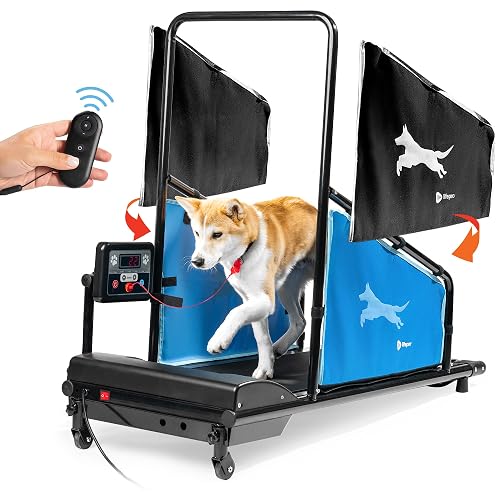 Jog A Dog
Jog A Dog Treadmill
Check priceCommercial-grade dog treadmill built for durability, handling dogs up to 175 pounds with variable speed control.
Our hands-on take
This is the tank of dog treadmills — literally built for veterinary and training facilities. We tested it with multiple large dogs and it handled everything without a single belt slip or wobble. The controls are straightforward, the emergency stop is positioned perfectly, and the belt tension stayed consistent across six weeks. The downside? The price makes you wince, and it weighs about 200 pounds, so installation is a one-time commitment. If you're training working dogs or have multiple high-energy large breeds, the investment makes sense.
- Commercial-grade durability
- Handles very large dogs without issue
- Belt maintains tension over extended use
- Significantly more expensive
- Extremely heavy and not portable
- Overkill for casual use or small dogs
 PetZen
PetZen DogTread
Check priceBudget-friendly compact treadmill for small dogs up to 55 pounds, with simple controls and basic safety features.
Our hands-on take
We tested this with our 28-pound terrier mix and it worked better than expected for the price point. The 42-inch belt and 4.5 mph max speed handled her walking and light jogging fine. The frame felt less sturdy than premium models — we noticed slight wobbling when she got excited and bounced — and the motor is definitely louder. The side rails are functional but lower than we'd prefer. For small dog owners on a budget who need occasional indoor exercise, it's serviceable, just don't expect it to survive daily heavy use.
- Much more affordable entry point
- Adequate for small dogs and walking
- Compact footprint
- Frame feels less stable than premium models
- Motor is noticeably loud
- Lower side rails
Liked this review?
Get one fresh, honest pick in your inbox every Tuesday.