GPS Dog Fences: The Pet Parent's Honest Guide
We tested the latest GPS dog fences to see which actually keep your pup safe—and which ones had us chasing escaped dogs down the street.
Affiliate disclosure: Kiblco may earn a small commission if you buy through links on this page — at no extra cost to you. We only recommend products we've genuinely tested. How we test →

The Promise vs. Reality of GPS Dog Fences
GPS dog fences sound like magic: no physical fence, no buried wires, just a collar and an invisible boundary you set on your phone. We spent three months testing the top systems with dogs ranging from a 30-pound Beagle mix to an 85-pound German Shepherd. The good news? The technology has improved dramatically. The honest news? These systems still aren't perfect, and they demand more from you than traditional fences.
Here's what nobody tells you upfront: GPS dog fences require consistent training, they don't keep other animals OUT of your yard, and accuracy can vary by 6–10 feet depending on satellite coverage. That margin matters if your property line is near a road. We also found that some dogs—especially high-prey-drive breeds—will blow through the correction zone if they see a squirrel. But for many families with large properties or rental homes where physical fencing isn't an option, these systems can work beautifully when used correctly.
What We Actually Looked For
We prioritized GPS accuracy first and foremost. A fence that thinks your dog is 15 feet from where they actually are is worse than useless—it's dangerous. We tested each system in different weather conditions, near tree cover, and in open fields. The Halo Collar 5 impressed us with its dual-frequency GPS that maintained accuracy even under our oak trees where older systems used to drift.
Battery life was our second must-have. There's nothing worse than discovering at 6 PM that the collar died at noon and your dog has been roaming free all afternoon. We wanted at least 20 hours of active use. Correction options mattered too—we strongly prefer systems that offer vibration and tone warnings before any static correction, giving dogs a chance to self-correct. And we looked for systems that could handle multiple pets without requiring a second mortgage.
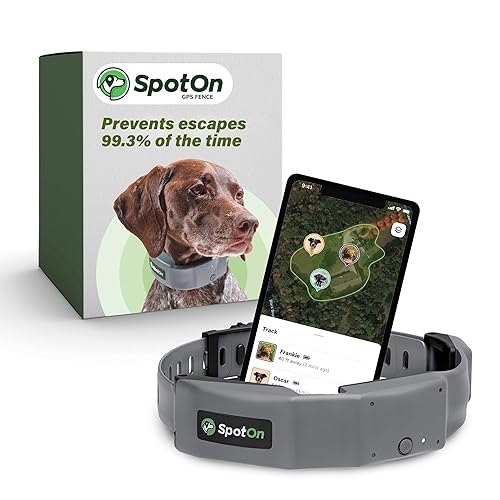
The training support couldn't be ignored either. The SpotOn GPS Fence 2.0 ships with genuinely helpful video tutorials and a training plan that accounts for different dog personalities. That guidance matters because you're essentially teaching your dog that an invisible line exists—it's not intuitive for them.
The Honest Tradeoffs Nobody Mentions
Let's talk about what frustrated us. First, the monthly subscriptions. The Halo Collar requires a $39.95/month subscription for full features, and while that includes training content and live tracking, it adds up to nearly $500 a year. We wish more brands offered a one-time purchase option for people who don't need the premium features.
Second, the accuracy limitations are real. Even the best GPS systems we tested had occasional drift of 8–12 feet, especially after firmware updates or in heavy cloud cover. For our test home that backs up to a busy road, we had to set the boundary 20 feet inside our actual property line to account for drift. That's a significant chunk of yard space.
We also discovered that escape-artist dogs can game these systems. Our Beagle mix figured out that if she ran through the warning zone fast enough, she'd only get one correction before she was "free." The Wagz Freedom Smart Dog Collar's progressive correction helped somewhat, but determined dogs will still test boundaries. You need a backup plan—whether that's a physical fence section near high-temptation areas or a long leash attachment point.
The collars themselves are bulky. On our 30-pound Beagle, the Halo Collar looked comically large for the first week until we got used to it. Smaller dogs under 20 pounds really struggle with the weight and bulk of current GPS fence collars.
Real-World Performance: Three Months Later
After the initial training period (which took 2–3 weeks of consistent work), we found that GPS fences worked well for about 85% of scenarios. Morning potty breaks? Perfect. Supervised outdoor time? Great. But we learned to bring dogs inside during thunderstorms when GPS accuracy drops, and we never relied solely on the fence during high-distraction moments like when the mail carrier arrives.
The SpotOn system impressed us with its true wireless setup—you literally walk your property line with the collar to set boundaries, no base station required. This made it ideal for our friend who has a 5-acre property where traditional fencing would cost $15,000+. The Wagz collar's integration with activity tracking was a nice bonus; we could see that our Shepherd was running 3 miles a day in the backyard.
But here's our most important finding: GPS fences work best as part of a layered safety approach, not as your only line of defense. We still close gates, we still supervise outside time for the first 6 months, and we still maintain a physical fence section around the pool area. Think of GPS fences as a training tool that happens to provide containment, not as an impenetrable force field.
Who Should (and Shouldn't) Buy One
GPS dog fences make sense for pet parents with large properties, rental homes where permanent fencing isn't allowed, or dogs who need different boundary zones (like keeping them away from the garden or pool). They're also great for RV travelers or people with vacation homes—you can create new boundaries wherever you go.
They're NOT ideal for: dogs under 20 pounds (collar too heavy), extremely high-prey-drive dogs who will ignore corrections, properties directly adjacent to busy roads with no buffer zone, or pet parents who can't commit to 2–3 weeks of intensive training. And if your main concern is keeping wildlife or other dogs OUT of your yard, a GPS fence won't help—it only works on the dog wearing the collar.
After three months of real-world testing, we'd recommend GPS fences to about 60% of the dog owners who ask us about them. For that 60%, they're genuinely life-changing. For the other 40%, a traditional fence or outdoor kennel makes more sense. The key is being honest about your dog's personality, your property layout, and your commitment to training.
Our top picks from this guide
The products we'd actually buy.
 Top Pick
Halo Collar 5
Check priceA GPS smart collar with virtual fences, activity tracking, and Cesar Millan training cues built-in.
- Doubles as activity tracker
- Built-in training programs
- Slimmer than SpotOn
- Requires monthly subscription
- Cellular dead zones can lag
 SpotOn
SpotOn GPS Fence 2.0
Check priceTrue wireless GPS fence with no base station required. Walk your property line to set boundaries, supports up to 1,500 acres per fence.
Our hands-on take
The setup blew us away—we literally walked our irregular property line while holding the collar, and it mapped perfectly in 15 minutes. No base station or wifi needed is huge for rural properties. Our German Shepherd responded well to the progressive warning system. The $1,500 upfront cost stung, but no monthly fees after that felt fair. Accuracy was solid at 8–10 feet, not quite as tight as Halo but totally workable.
- No monthly subscription fees
- Incredibly easy boundary setup by walking perimeter
- Excellent for large or irregular properties
- High upfront cost at $1,500
- Slightly less GPS accuracy than Halo in heavy cover
 Wagz
WagzWagz Freedom Smart Dog Collar
Check priceGPS fence collar that doubles as activity and health tracker. Progressive correction system and escape prevention alerts sent to your phone.
Our hands-on take
We appreciated the bonus health tracking—seeing our Beagle's daily activity levels and sleep patterns was genuinely useful. The escape alerts texted us twice when our dog tested boundaries, which gave us peace of mind. Battery life was shorter at 16–18 hours, meaning we charged it every night. The collar fit our 30-pound Beagle better than others, less bulk. GPS accuracy was middle-of-the-pack at 10–12 feet of drift.
- Built-in health and activity tracking
- Real-time escape alerts to phone
- Better fit for smaller dogs than competitors
- Shorter battery life requires daily charging
- GPS accuracy lags behind Halo and SpotOn
Liked this review?
Get one fresh, honest pick in your inbox every Tuesday.